This image has been going around in my Facebook and Plurk circles. It shows the average annual salary of graphic designers in different countries around the world.
It's fascinating to see how much designers are getting in countries like the United States, Australia and Switzerland. At the same time, it's pretty dismal to see how little graphic designers in Asia are getting in comparison. The Philippines is by far the lowest of the bunch.
When you convert that to Philippine Pesos, I suppose it's not such a bad deal. However, this graphic shows us that we can get more if we wanted to. I'm wondering though, what are the factors that affect this study? Are these figures based off the local clients, or overall clients that the graphic designers get? Or are clients willing to pay that much only because of where the designers are located?
Writers in the Philippines are in a similar predicament. At least, from what I'm seeing in the freelance boards I go to. Many people who are looking for writers prefer to get from places like the Philippines or India because their bids are low and they are willing to work for small amounts. Granted, when converted to the local currency it may be substantial, but the tradeoff is you have to write a lot before you can actually get a good amount. It's pretty much a bidding war most of the time, and often it's not the best writer who gets the job, but the one with a much lower rate.
Here's hoping that we can soon lift this kind of restriction (for lack of better word) for our graphic designers, writers, artists and the like.
Showing posts with label freelance. Show all posts
Tuesday, February 14, 2012
Thursday, February 10, 2011
oDesk offers funds transfer directly to your Philippine bank account!
Great news for all oDesk contractors in the Philippines! oDesk is now offering local funds transfer, where you can directly deposit your earnings into your Philippine bank account for a low, flat fee. This eliminates the need for a third party vendor, such as Payoneer or PayPal. Instead, all your money goes directly to your bank account (in pesos too!) through the local clearing system.
It takes 3 to 5 business days for your funds to be properly transferred. Local funds transfer in the Philippines is still in the beta stage, but oDesk assures contractors that the system is sound and their money is in good hands. It's in the beta stage because they know it can improve in the future.
Setting up the local funds transfer is a one-step activation process. You just need your bank's head office BRSTN code, your account number and information. While oDesk charges $1.99 for each transfer, you may incur other charges, such as incoming remittance fees. It's best to ask if your bank has other charges when receiving a BRSTN local funds transfer. oDesk did mention that due to their existing tie-ups with several local banks, these fees won't be very steep.
For a complete list of details, please view this post at the oDesk website. You can also check out the discussion thread. A lot of my questions have been answered just by reading through it.
I'm going to sign up for this. I'm currently using Payoneer and the fees are killing me. Imagine a $20 transfer will incur up to more than $5 in fees just to get the money to Payoneer. I think it's fast and convenient, but not worth it if you're only going to be transferring minimum amounts. I'm trying out Paypal which is somewhat cheaper (transfer from Paypal to local bank, charges may apply too).
This service is open to all Philippine oDesk contractors. Other countries have their own local funds transfer too. It sounds like a very easy solution for all our withdrawal woes (hoy, wag ka bastos! :p) I'm glad oDesk decided to bring this service to us. I can't wait to try it, especially since according to that post, BPI doesn't have any incoming remittance charges! :D
Have you tried this? Will you sign up for it? I'd love to hear about your experience if you have.
January 2012 Update: I was able to try this a few months after I posted this. When my account reached a little over PHP 10,000, I facilitated the transfer. It was pretty quick, and it took less than two days to get from my oDesk account to my BPI savings account. And yes, no remittance charges (compared to transferring from PayPal to BPI).
It takes 3 to 5 business days for your funds to be properly transferred. Local funds transfer in the Philippines is still in the beta stage, but oDesk assures contractors that the system is sound and their money is in good hands. It's in the beta stage because they know it can improve in the future.
Setting up the local funds transfer is a one-step activation process. You just need your bank's head office BRSTN code, your account number and information. While oDesk charges $1.99 for each transfer, you may incur other charges, such as incoming remittance fees. It's best to ask if your bank has other charges when receiving a BRSTN local funds transfer. oDesk did mention that due to their existing tie-ups with several local banks, these fees won't be very steep.
For a complete list of details, please view this post at the oDesk website. You can also check out the discussion thread. A lot of my questions have been answered just by reading through it.
I'm going to sign up for this. I'm currently using Payoneer and the fees are killing me. Imagine a $20 transfer will incur up to more than $5 in fees just to get the money to Payoneer. I think it's fast and convenient, but not worth it if you're only going to be transferring minimum amounts. I'm trying out Paypal which is somewhat cheaper (transfer from Paypal to local bank, charges may apply too).
This service is open to all Philippine oDesk contractors. Other countries have their own local funds transfer too. It sounds like a very easy solution for all our withdrawal woes (hoy, wag ka bastos! :p) I'm glad oDesk decided to bring this service to us. I can't wait to try it, especially since according to that post, BPI doesn't have any incoming remittance charges! :D
Have you tried this? Will you sign up for it? I'd love to hear about your experience if you have.
January 2012 Update: I was able to try this a few months after I posted this. When my account reached a little over PHP 10,000, I facilitated the transfer. It was pretty quick, and it took less than two days to get from my oDesk account to my BPI savings account. And yes, no remittance charges (compared to transferring from PayPal to BPI).
Wednesday, September 15, 2010
Bidding wars
I started working at oDesk with an hourly rate of $3. I increased it to $5 but sadly, I get a lot of "bid is too high" responses. I acknowledge that while don't fully understand the dynamics of how buyers get their funds to pay for the work they need, it is still rather annoying and disheartening to receive such notices when I know that one, my rate is not high compared to other providers, and two, what I am charging is still affordable enough for great quality work.
What many buyers might not consider is the worth of the dollar to the person who is looking for work. A dollar is worth about forty to fifty pesos in the Philippines, depending on the market, but it usually falls around in that range. It may sound big --- if you tend to think that what fifty bucks can buy is the same as what you can get with a dollar.
In most cases it is not. In order for someone to live substantially here, you have to at least earn P500 a day. That's about $10 (again, depending on the exchange rate), and that's only for the daily expenses. In other countries, a person earning $10 an hour is standard. Ten dollars a day is not enough, especially if a person has to pay his bills and sustain a family.
Some writers accept a low paying work because they accept other work as well. Totaling what they earn for all that would most likely net them a substantial amount. Then again, it would be undermining their talents and skills, and sometimes, getting bulk work compromises the quality of the articles.
I also noticed that many buyers prefer to get people from non-US countries because they will take a dollar per article rate. Browsing through some writing forums, I've learned that many writers consider a $10 per article rate the bare minimum, as it's the rate many US writers charge.
In many instances, it's a strike against me to have the Philippines listed as my location. Buyers immediately think I'll be willing to accept a very low rate for my work. While I do want to get a job, I too have my standards. I have a university degree and more than ten years of writing experience in various fields under my belt. I speak and write English as well as anyone who is from an English speaking country. In fact, I learned how to speak it alongside the vernacular language. English is not a second language for me, but one of my primary languages.
Still think the bid is too high? Here are some suggestions you can look into to help you decide what to do next.
1. Check the provider's work. Make a portfolio a requirement for applicants. Do they write in the way that you want your articles to come out? Are they up to your standards of "perfect English grammar"? Is their work original and pass Copyscape? These are common requirements I see in many job postings.
Even without asking, I include links to my blog so that the buyer will be able to look at how I write. I try to keep my blog as updated as possible, and write in a variety of styles. I am confident that my work is worth more than my current oDesk bid. I've seen some writing samples of people who bid around a dollar or so for their work and honestly, it is worth even less.
2. If you think the rate is too high even after you've checked the provider's work, don't cancel the bid just yet. Ask the provider if they would be willing to negotiate their rate to meet your budget. While many would not consider doing so, there would be others who would be willing to. If by chance they cannot lower it to the exact amount that you need, try to see if you can compromise to an amount that would be satisfactory to both of you.
3. Consider the kind of job you want them to do. Seriously, a 500 word article is not easy to write. If you could do it quickly, then I'm sure you wouldn't be looking for a writer now, right? Think of all the work that goes into it: research, writing the draft, the cycle of editing and rewriting until you get it right. I've looked into freelance forums and writing forums and many agree that a dollar for one article that includes research and editing is a very low rate. Even if the data has been provided, it still is a low rate.
4. Look into the writer's feedback, history and testimonials, if they are any (usually for sites like oDesk there would be). Is it good? Does it meet your standards? Or are you seeing low scores and ratings? I'd personally pick a writer who charges $10 per article (or hour, depending) if I am confident that they can meet my demands, versus someone charging a dollar but has issues with deadlines and quality.
5. In relation to the previous items, check the writer's credentials. With the Internet, there has been a proliferation of people who call themselves writers, mostly because they get their works published in a blog or an online publication. As previously mentioned, you can ask for work samples and use them as a measuring stick. My research showed that many prefer to look for seasoned writers over people who just blog, unless their entries are truly good.
I hope that buyers would see that sometimes, just because it's cheap, doesn't mean it's good. There are some things that are worth spending money for, and if you truly want great value for your dollar, well, you will get what you pay for.
What many buyers might not consider is the worth of the dollar to the person who is looking for work. A dollar is worth about forty to fifty pesos in the Philippines, depending on the market, but it usually falls around in that range. It may sound big --- if you tend to think that what fifty bucks can buy is the same as what you can get with a dollar.
In most cases it is not. In order for someone to live substantially here, you have to at least earn P500 a day. That's about $10 (again, depending on the exchange rate), and that's only for the daily expenses. In other countries, a person earning $10 an hour is standard. Ten dollars a day is not enough, especially if a person has to pay his bills and sustain a family.
Some writers accept a low paying work because they accept other work as well. Totaling what they earn for all that would most likely net them a substantial amount. Then again, it would be undermining their talents and skills, and sometimes, getting bulk work compromises the quality of the articles.
I also noticed that many buyers prefer to get people from non-US countries because they will take a dollar per article rate. Browsing through some writing forums, I've learned that many writers consider a $10 per article rate the bare minimum, as it's the rate many US writers charge.
In many instances, it's a strike against me to have the Philippines listed as my location. Buyers immediately think I'll be willing to accept a very low rate for my work. While I do want to get a job, I too have my standards. I have a university degree and more than ten years of writing experience in various fields under my belt. I speak and write English as well as anyone who is from an English speaking country. In fact, I learned how to speak it alongside the vernacular language. English is not a second language for me, but one of my primary languages.
Still think the bid is too high? Here are some suggestions you can look into to help you decide what to do next.
1. Check the provider's work. Make a portfolio a requirement for applicants. Do they write in the way that you want your articles to come out? Are they up to your standards of "perfect English grammar"? Is their work original and pass Copyscape? These are common requirements I see in many job postings.
Even without asking, I include links to my blog so that the buyer will be able to look at how I write. I try to keep my blog as updated as possible, and write in a variety of styles. I am confident that my work is worth more than my current oDesk bid. I've seen some writing samples of people who bid around a dollar or so for their work and honestly, it is worth even less.
2. If you think the rate is too high even after you've checked the provider's work, don't cancel the bid just yet. Ask the provider if they would be willing to negotiate their rate to meet your budget. While many would not consider doing so, there would be others who would be willing to. If by chance they cannot lower it to the exact amount that you need, try to see if you can compromise to an amount that would be satisfactory to both of you.
3. Consider the kind of job you want them to do. Seriously, a 500 word article is not easy to write. If you could do it quickly, then I'm sure you wouldn't be looking for a writer now, right? Think of all the work that goes into it: research, writing the draft, the cycle of editing and rewriting until you get it right. I've looked into freelance forums and writing forums and many agree that a dollar for one article that includes research and editing is a very low rate. Even if the data has been provided, it still is a low rate.
4. Look into the writer's feedback, history and testimonials, if they are any (usually for sites like oDesk there would be). Is it good? Does it meet your standards? Or are you seeing low scores and ratings? I'd personally pick a writer who charges $10 per article (or hour, depending) if I am confident that they can meet my demands, versus someone charging a dollar but has issues with deadlines and quality.
5. In relation to the previous items, check the writer's credentials. With the Internet, there has been a proliferation of people who call themselves writers, mostly because they get their works published in a blog or an online publication. As previously mentioned, you can ask for work samples and use them as a measuring stick. My research showed that many prefer to look for seasoned writers over people who just blog, unless their entries are truly good.
I hope that buyers would see that sometimes, just because it's cheap, doesn't mean it's good. There are some things that are worth spending money for, and if you truly want great value for your dollar, well, you will get what you pay for.
Saturday, September 05, 2009
Congratulations all around!
Early this month I received and email from oDesk saying that I made their Top 25 list of Best Freelance Writers for August 2009! I was really surprised because I only had one job and I felt that I didn't put enough hours on it.
Still, it felt really great to read that letter. Congratulations to the other writers as well!
Here's the rest of the best oDesk providers in all categories for August.
Still, it felt really great to read that letter. Congratulations to the other writers as well!
Here's the rest of the best oDesk providers in all categories for August.
Labels:
filipino writers,
freelance,
home work,
odesk,
writing
Tuesday, August 04, 2009
Looking for your first oDesk job
So you've taken the oDesk Readiness Test, as well as some other tests that befit your skills. You've filled up your resume and from any person's point of view, it's impressive. You're now ready to look for your first oDesk job. How to do it?
My first job was offered to me, actually. I don't recall applying for it, as the topic was something I wasn't familiar with. The only thing I know about architecture and interior design were the things I read in my mother's books and magazines. My second job was pretty much similar. However, with both jobs, I learned along the way. Sometimes you won't find your "dream job" on oDesk. As a writer, I've yet to come across a job with a topic that I like from the get-go. However, you'll find that even the oddest topics can be quite fun and fulfilling. I feel lucky that the topics of the work I got were ones that I had some interest in, so it was easy to work on.
How to look for oDesk jobs
1. When you log in, you'll find a menu on the very top of the page. Choose "Find providers and jobs." You can either choose to click on it or from the drop-down box, choose "Find jobs."

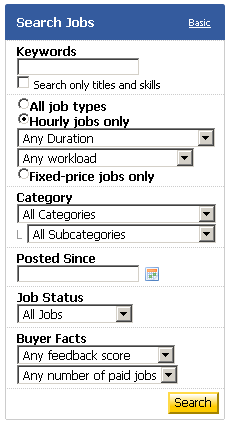
2. On the next page, you'll see some search options to the left of the screen.

All you have to do is fill it in. You can type keywords of the type of work you're looking for, and choose from the options below. Since I'm a writer, I choose "Writing and Translation" from the category list. I usually leave the sub-category as it is, because sometimes find interesting jobs under other headings.
If you don't want to take the risk of getting "bad job openings," you can adjust the buyer facts. Feedback score would mean what people say about that person offering a job, while "any number of paid jobs" would mean that the company/employer has already had work done by someone and successfully paid them.
The time of the work can also be changed. I often pick hourly jobs, and work that requires ten hours or less because I can squeeze that in my day job hours. It's up to you though, as you know best how much time you can devote to the work.
Is this for me?
After you click on "search," a list of prospective jobs will show up. Browse through them, and click on the title to view the job details, as the list will only be a summary of what it's about. Each job lists when it was posted and when the job is planned to start. They'll also provide you details on what they want done and such. Don't hesitate to ask questions if you need some things clarified. Better to spend a time on that than waste time applying and finding out the job isn't for you after all.
Applying for the job
When you click on "Apply," you will be lead to a page where you need to type a cover letter. I'm not sure how formal a letter this should be, but if you have any doubts, oDesk provides a sample of good vs. bad cover letter. I also kept copies of my previous application letters and adjusted them as needed for the job that I'm applying for. Once, I tried doing an informal letter. I didn't get any feedback from that though, so if you must do the same, proceed with caution.
You can attach files to your letter too. These could be pictures or other documents that show samples of your work, and is often used by those who don't have sites.
Click on box on the terms and agreements, and your application has been submitted. All you have to do now is wait for the employer's reply.
Some notes
From my experience, not every application you send out gets accepted. Sometimes, you're even lucky if you get a reply. Most of the time I learn about the job when I receive a message saying it was either closed, or that I wasn't picked. I don't want to blame the employers on this, especially those that have many applicants (sometimes, the good and easy jobs get at least forty applicants).
Don't be discouraged though. Just because they didn't reply or you didn't get the job, doesn't mean they haven't read your application or looked at your profile. I've seen my profile marked as a favorite by some employers. This means that they like my work and are considering me for future work. That's a positive sign, especially since I've only had two jobs since I started out.
That's it for the basics of looking for jobs at oDesk. Hope that helps.
My first job was offered to me, actually. I don't recall applying for it, as the topic was something I wasn't familiar with. The only thing I know about architecture and interior design were the things I read in my mother's books and magazines. My second job was pretty much similar. However, with both jobs, I learned along the way. Sometimes you won't find your "dream job" on oDesk. As a writer, I've yet to come across a job with a topic that I like from the get-go. However, you'll find that even the oddest topics can be quite fun and fulfilling. I feel lucky that the topics of the work I got were ones that I had some interest in, so it was easy to work on.
How to look for oDesk jobs
1. When you log in, you'll find a menu on the very top of the page. Choose "Find providers and jobs." You can either choose to click on it or from the drop-down box, choose "Find jobs."

2. On the next page, you'll see some search options to the left of the screen.

All you have to do is fill it in. You can type keywords of the type of work you're looking for, and choose from the options below. Since I'm a writer, I choose "Writing and Translation" from the category list. I usually leave the sub-category as it is, because sometimes find interesting jobs under other headings.
If you don't want to take the risk of getting "bad job openings," you can adjust the buyer facts. Feedback score would mean what people say about that person offering a job, while "any number of paid jobs" would mean that the company/employer has already had work done by someone and successfully paid them.
The time of the work can also be changed. I often pick hourly jobs, and work that requires ten hours or less because I can squeeze that in my day job hours. It's up to you though, as you know best how much time you can devote to the work.
Is this for me?
After you click on "search," a list of prospective jobs will show up. Browse through them, and click on the title to view the job details, as the list will only be a summary of what it's about. Each job lists when it was posted and when the job is planned to start. They'll also provide you details on what they want done and such. Don't hesitate to ask questions if you need some things clarified. Better to spend a time on that than waste time applying and finding out the job isn't for you after all.
Applying for the job
When you click on "Apply," you will be lead to a page where you need to type a cover letter. I'm not sure how formal a letter this should be, but if you have any doubts, oDesk provides a sample of good vs. bad cover letter. I also kept copies of my previous application letters and adjusted them as needed for the job that I'm applying for. Once, I tried doing an informal letter. I didn't get any feedback from that though, so if you must do the same, proceed with caution.
You can attach files to your letter too. These could be pictures or other documents that show samples of your work, and is often used by those who don't have sites.
Click on box on the terms and agreements, and your application has been submitted. All you have to do now is wait for the employer's reply.
Some notes
From my experience, not every application you send out gets accepted. Sometimes, you're even lucky if you get a reply. Most of the time I learn about the job when I receive a message saying it was either closed, or that I wasn't picked. I don't want to blame the employers on this, especially those that have many applicants (sometimes, the good and easy jobs get at least forty applicants).
Don't be discouraged though. Just because they didn't reply or you didn't get the job, doesn't mean they haven't read your application or looked at your profile. I've seen my profile marked as a favorite by some employers. This means that they like my work and are considering me for future work. That's a positive sign, especially since I've only had two jobs since I started out.
That's it for the basics of looking for jobs at oDesk. Hope that helps.
Saturday, June 20, 2009
Starting on oDesk
I've been seeing a lot of posts in the oDesk forums about newbies having a hard time with the site and its system. I understand that at first it's really daunting, especially since you have to take the oDesk Readiness Test. It wasn't a requirement early last year, but as more and more people join oDesk, it became mandatory. I joined oDesk a week after they implemented it, so I had to take the test.
Here's some simple tips to help you with oDesk.
I've only been on oDesk for a year and had two jobs, but so far I have no complaints. I hope you have a great experience (as well as earn much) as well. Cheers!
Here's some simple tips to help you with oDesk.
- For the oDesk Readiness Test, I decided to play around the site first before I took it. Although the test question provides you a link to either the FAQ or the page where you can find the answer, it's best to be familiar with the site so you don't waste time searching during the test.
- Once you've passed, take other tests that would be relevant to your job. You can even take those that won't. If you fail, hide the test results from public view and retake it.
- Be truthful and realistic about your skills, achievements and accomplishments. Include links to sites, projects or portfolios that you have and are relevant to the job/field you wish to get. Keep them updated. Buyers want to know what they're getting before they commit. If you don't have the right experience and mislead them with your portfolio, they may put that in your feedback and further lower your chances of getting a job.
- Join the oDesk community for your country. It helps, believe me, especially when it comes to the concerns of payment methods, transaction charges and payouts. Plus, the people can give you support if you feel that you aren't doing well in job hunting.
- I stuck with looking for jobs in writing, as that's my forte, but I also started looking for work as an illustrator and web designer. Learn skills that are in demand (which you can find out about in the oDesk Trends) and branch out. Jobs will come your way more.
- Lastly, when you do get your job, devote your time, skills and energy to it as you would in a job you have to go to the office for. Just because it's a virtual job doesn't mean it's less important. Excellent work may net you another job with the client, or a referral.
- Once the job is done, leave a feedback and ask for one in return. If the client declines, thank them and move on. It's up to you if you want to do the same.
I've only been on oDesk for a year and had two jobs, but so far I have no complaints. I hope you have a great experience (as well as earn much) as well. Cheers!
Saturday, July 26, 2008
Writing for oDesk
I decided to jump in on the online work force a few months ago. My friend Denise was a writer for an offshore company, and though she was earning good money from that, she wasn't happy with what she was doing. Given that she had a lot of free time, she decided to look for online writing jobs. Her feedback is positive, and that encouraged me to take the plunge.
I signed up for oDesk, but it took me a while to get my profile up and running. I made an account just when they rolled in their new system, so I had to take the oDesk readiness test. Thankfully, I passed it and I was on the Top 10%.
I didn't really apply for any jobs just yet, because I didn't feel like I was ready. I was surprised when someone left me a note inviting me for an interview. Figuring that I won't lose anything, I gave it a shot.
I am now working as a freelance writer for an architectural and interior design site. The work is light, and it involves mostly research about designers and their work. It's been almost a month since I started and it's going along pretty well. My employers are great; they're online most of the time and I can easily ask them questions about my work even if they're located on the other side of the world an on opposite timezones. My teammates are helpful, and one of the is like my "mentor" who sends me updates and tips on how to maximize the quality of my work. Payment is done in a timely manner too, so that's a plus.
My experience with oDesk is good. Some people don't seem to be happy with the software the site requires its providers to install. I do however, find it a rather fair way to monitor one's work hours and methods. I wouldn't want to pay anyone for not really doing their work, and I also wouldn't want to give out shabby work to my employers. However, this method may not work for everyone, so I do advise you to proceed at your own discretion. I haven't compared it with other systems, so I don't really know what is the standard.
Recently, another company offered me a job as a web content writer. I was really stoked to get more invites, however, I had to decline it. Still, it was great to see that my profile was being looked at, and that I do have the skills that many companies are looking for. As soon as this project is finished, I'll check on some new ones.
I signed up for oDesk, but it took me a while to get my profile up and running. I made an account just when they rolled in their new system, so I had to take the oDesk readiness test. Thankfully, I passed it and I was on the Top 10%.
I didn't really apply for any jobs just yet, because I didn't feel like I was ready. I was surprised when someone left me a note inviting me for an interview. Figuring that I won't lose anything, I gave it a shot.
I am now working as a freelance writer for an architectural and interior design site. The work is light, and it involves mostly research about designers and their work. It's been almost a month since I started and it's going along pretty well. My employers are great; they're online most of the time and I can easily ask them questions about my work even if they're located on the other side of the world an on opposite timezones. My teammates are helpful, and one of the is like my "mentor" who sends me updates and tips on how to maximize the quality of my work. Payment is done in a timely manner too, so that's a plus.
My experience with oDesk is good. Some people don't seem to be happy with the software the site requires its providers to install. I do however, find it a rather fair way to monitor one's work hours and methods. I wouldn't want to pay anyone for not really doing their work, and I also wouldn't want to give out shabby work to my employers. However, this method may not work for everyone, so I do advise you to proceed at your own discretion. I haven't compared it with other systems, so I don't really know what is the standard.
Recently, another company offered me a job as a web content writer. I was really stoked to get more invites, however, I had to decline it. Still, it was great to see that my profile was being looked at, and that I do have the skills that many companies are looking for. As soon as this project is finished, I'll check on some new ones.
Subscribe to:
Posts (Atom)